
Where do gold colors come from? The complete guide to gold alloys
Gold is yellow in nature. Yet jewelry store windows display pieces in pink, white, and sometimes almost grey. This is neither an illusion nor a trick. Gold colors come from a simple principle: mixing. By adding other metals to pure gold, you get an alloy whose shade, strength, and price change in predictable ways. This guide explains everything, from the first glance in the store to the hallmark stamped inside your ring.
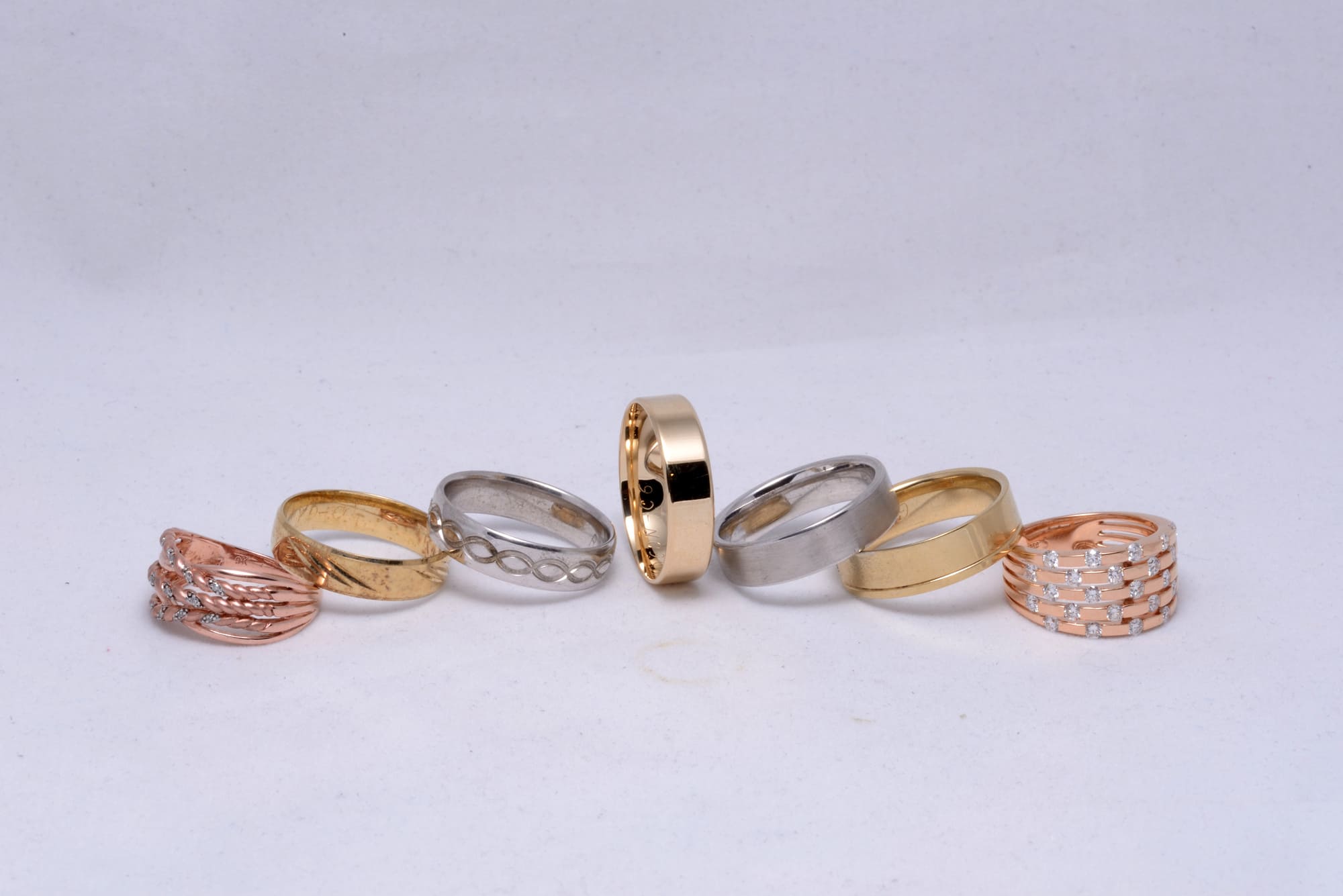

Key takeaways
- Pure gold (24 karat) is naturally yellow but too soft to be worn every day.
- The color of a piece of jewelry depends on the metals mixed with the gold: copper for pink, palladium or silver for white.
- The karat number (10K, 14K, 18K) indicates the amount of pure gold in the piece.
- A white gold piece that turns yellow is neither fake nor damaged: its protective coating has simply worn away over time.
- In jewelry, “karat” refers to the purity of gold, which is not the same thing as the carat of a diamond.
Why isn’t gold always yellow?
Pure gold is indeed yellow. It is a natural property of the metal, just as copper is reddish-orange. This gold in its pure state is called 24-karat gold.
But pure gold has a characteristic that complicates its use in jewelry: it is very malleable. A 24-karat gold ring would gradually lose its shape with daily wear. This is also why you won’t find 24K gold jewelry in stores: this grade is reserved for bullion bars and collector coins.
The solution has existed since antiquity: mixing gold with other metals to strengthen it. This mixture is called an alloy. And it is the nature of these added metals that changes the final color of the piece. Add copper and you obtain pink. Add silver and palladium and you move toward white. Keep the balance between the two, and the gold stays yellow.
A useful clarification before going further: In jewelry, the word “karat” refers to the purity of gold, not its weight. A 2-carat diamond and a 14-karat gold ring have nothing in common; they simply share the same word.
The manufacturing secrets behind the different gold colors
Three colors dominate jewelry around the world: yellow, pink, and white. Each follows a precise recipe, has its own history, and has its own care rules.
Yellow gold: the original color
Yellow gold is the alloy that comes closest to the natural shade of gold. Copper and silver are added in equal proportions so that their effects cancel each other out. The result: the golden color remains intact.
For 18 karat yellow gold, the typical composition is 75% gold, 12.5% silver, and 12.5% copper. For 14 karat, the gold share drops to about 58%, and the color becomes slightly warmer, more orange.
It is the oldest color in jewelry, present in all the great civilizations of antiquity. It is particularly prized in Indian, Middle Eastern, and Mediterranean cultures. Its great advantage: no special care is needed. Its shade does not change over time.
Pink gold: it all comes from copper
The color of pink gold depends entirely on copper. The more there is in the alloy, the more intense the shade. For 18 karat pink gold, the usual composition is 75% gold, 20% copper, and 5% silver, the latter serving only to soften the shade.
Three shades are distinguished in this family: pale pink (less than 15% copper), classic pink (about 20%), and deep red (25% or more). The latter was very popular in Russia in the 19th century, hence its former name: “Russian gold.”
After a comeback in the 1920s, pink gold has once again established itself since the 2010s as one of the leading colors in contemporary jewelry. Like yellow gold, it requires no surface treatment. Its color is permanent.
White gold and rhodium plating
White gold does not exist in its natural state. It is obtained by mixing pure gold with pale metals (mainly palladium and silver) that neutralize the yellow tint. But even after this mixing, the result remains slightly yellowish or greyish.
To obtain the brilliant white seen in stores, an additional step is needed: rhodium plating. A jeweler deposits a thin layer of rhodium on the piece, a metal from the platinum family that is very white and very durable. This layer is what gives white gold its characteristic shine.
This layer, however, has a limited lifespan. Daily friction, water, creams, and household products gradually wear it away. The piece then slowly returns to its base shade. This yellowing is completely normal and reversible: a jeweler can renew the rhodium and restore its original appearance. For a ring worn every day, rhodium plating is recommended about once every one to two years. For a necklace or earrings, every two to three years is enough.
There is an alternative: an alloy with a higher proportion of palladium, which naturally gives a whiter shade without requiring regular rhodium plating. This option costs more to manufacture but less to upkeep.
10K, 14K, or 18K: What influence on the final color?
The karat number simply indicates how much pure gold is in the piece. An 18K contains 75% gold. A 14K contains 58%. A 10K contains 42%. The rest is made up of the alloy metals.
The higher the karat, the more intense the color. This is true for yellow and pink gold. For white gold, the difference is less visible, because rhodium plating evens out the final appearance regardless of the gold content.
| Karat | Pure gold | Color (yellow gold) | Strength | Notes |
|---|---|---|---|---|
| 10K | 42% | Pale yellow | Very good | Legal minimum in Canada |
| 14K | 58% | Rich yellow | Good | Common standard in North America |
| 18K | 75% | Deep yellow | Fair | Common standard in Europe and Asia |
| 22K | 92% | Intense yellow | Low | Common in India and the Middle East |
| 24K | 99.9% | Bright yellow | Very low | Bullion only, not used in jewelry |
The hallmark: the sign that everything is in order
In Canada, the marking of gold jewelry is governed by the Precious Metals Marking Act, which is administered by the Competition Bureau of Canada.If a manufacturer or retailer chooses to apply a quality mark to a precious metal piece, the law requires that the mark be truthful so that consumers can trust the information and make informed purchasing decisions.
To be sold as gold in Canada, a piece of jewelry must have a minimum quality of 9K. In practice, 10K is the lowest grade commonly sold in jewelry stores. The hallmark can be expressed in karats (10K, 14K, 18K) or in thousandths (417, 585, 750); the two are equivalent.
In Europe, jewelry bears a state hallmark expressed in thousandths, accompanied by an official mark specific to each country. In India and much of South Asia, 22K is the dominant standard in the traditional market.
Why does a gold piece change appearance over time?
The color of the gold itself does not change. What changes is what happens on the surface. Several reasons can explain a change in appearance:
- Rhodium wear (white gold only): the white layer thins and reveals the natural shade of the alloy. A new rhodium plating at a jeweler’s is enough to fix everything.
- Everyday buildup: creams, soaps, perfumes, and chlorinated water accumulate on the surface. A gentle cleaning with warm soapy water generally solves the problem.
- Confusion with gold plating: a gold-plated piece is covered with a thin layer of gold over an ordinary metal. When this layer wears off, the base metal shows through, which can give a very different shade. This does not happen with solid gold jewelry (10K, 14K, or 18K).
To tell solid gold from gold plating, the most reliable indicator is the presence of a quality hallmark (10K, 14K, 585…). A solid gold piece does not wear away.

How to choose your color based on your lifestyle
There is no wrong answer. The best choice is the one you will enjoy wearing every day.
- Yellow gold is made for those who want jewelry without constraints. No treatment, no special care, its color stands the test of time effortlessly.
- Pink gold suits those looking for a warm, contemporary shade. Same advantage as yellow: no surface treatment, a permanent color.
- White gold is for those who prefer a sober, luminous look, close to platinum. Its only requirement is periodic rhodium plating, to be built into the regular care of the piece, as you would for a watch.
As for the choice of karat, it affects both shade and strength. For a piece worn every day, 14K often offers the best balance. If you would like to see the different colors side by side and get personalized advice, La Puce d’Or jewelry store would be delighted to welcome you.